
Date-code verification UK
Verify date, batch and lot codes on every pack
Use OCR or OCV machine vision to check that variable print is present, legible and consistent with the active production job—then act on missing or incorrect codes.
Direct answer
How does date-code verification work?
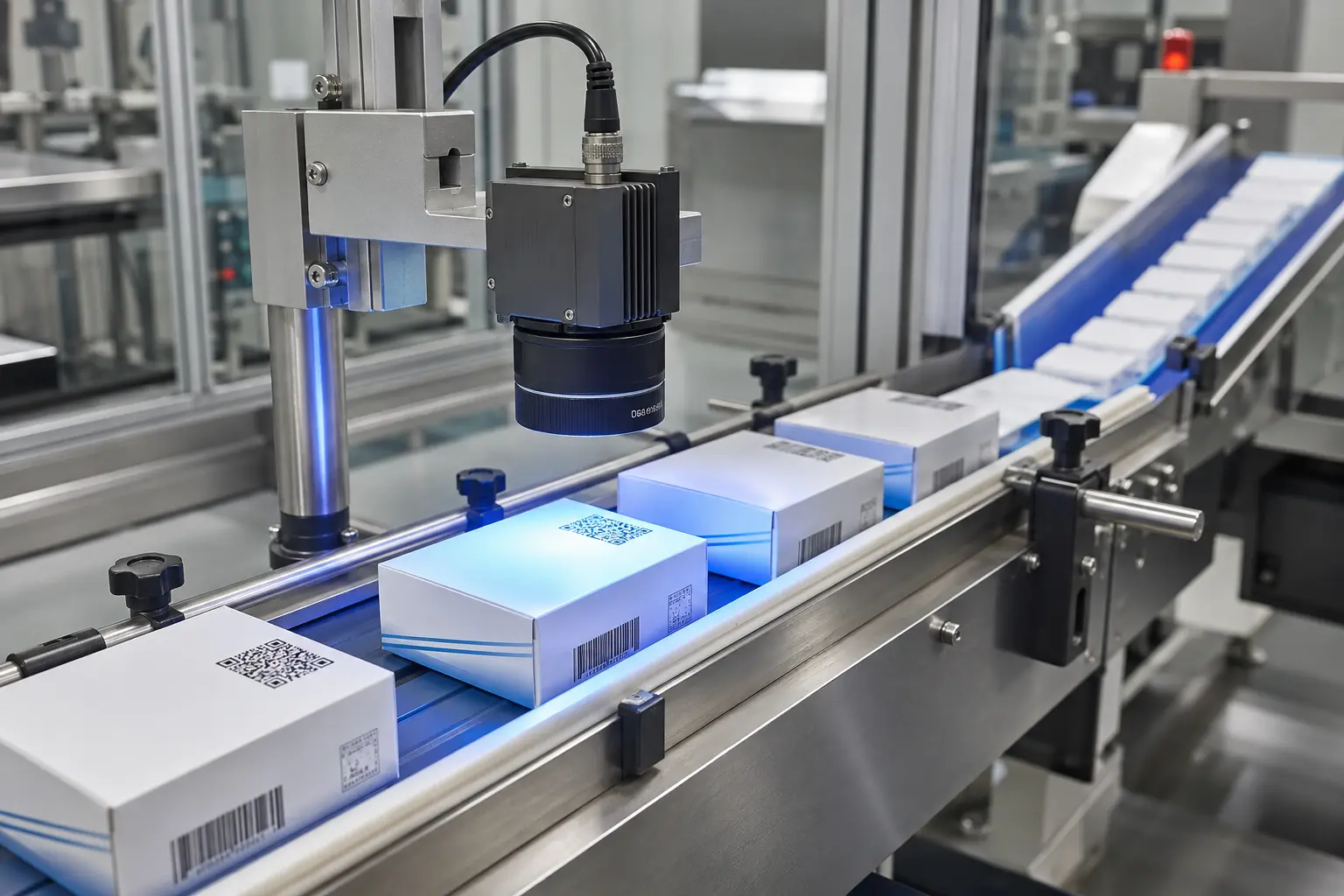
A date-code verification system captures the printed area after coding and checks the result against defined rules. OCR can read an unknown string; OCV can confirm that the observed characters match an expected best-before, use-by, manufacture, batch or lot value supplied by the active recipe.
The inspection can also check presence, location and basic print quality before returning a pass or fail decision. When combined with packaging verification, the same result can confirm that the date belongs to the correct product and packaging job.
Production outcomes
Turn printed text into a controlled production decision
Detect a value that does not match the job
Identify print drift before it worsens
Record results for production review
Expected printDate • batch • lot • line
How it works
Separate readability from correctness
A clearly printed date can still be the wrong date. A correct date can also be too faint, incomplete or outside the expected area. The system therefore needs both an image-quality decision and a data decision.
- 01
Receive the expected value
The production recipe, printer, PLC or database provides the text or rule that should be printed.
- 02
Capture the real mark
Lighting, exposure and optics are selected for the substrate, ink, motion and available print area.
- 03
Compare and control
The read result, confidence and format rules contribute to the accept, reject or line-stop decision.
Specify the right system
OCR, OCV and presence checking compared
These tools solve different problems and are often combined in one inspection recipe.
| Requirement | What the system checks | Why it matters |
|---|---|---|
| Presence check | Confirms a mark exists in the print area | Fast first defence against a blank pack |
| OCR | Converts observed characters into data | Useful when the printed value must be captured |
| OCV | Compares characters with an expected value | Useful when the correct string is known |
| Format rules | Checks length, separators or allowed patterns | Finds structurally invalid values |
Project route
From application review to production control
Performance depends on the real pack, print process, speed and fault route. Those conditions are proved before the final system is released.
Define the string
Agree the expected format, allowed characters and source of production truth.
Trial print variation
Test normal changes in contrast, position, substrate, speed and coder output.
Set fault logic
Define low-confidence, mismatch, no-print and communication-loss responses.
Validate changeover
Prove new job data, printer setup, inspection recipe and operator recovery.
Common questions
Date-code verification FAQs
These answers cover the first decisions. A sample trial establishes what is practical on your line.
Ask an engineerCan the system calculate the correct date?+
It can compare with a value supplied or calculated by the agreed production-control logic. Ownership of date rules and changeover data should be defined during the project.
Can it check inkjet, laser or thermal-transfer print?+
Potentially. Print size, contrast, substrate, motion and normal process variation are tested on representative samples before the imaging method is selected.
What happens when OCR confidence is low?+
The response is configurable. A low-confidence result can fail the product, request review or stop the line, depending on the risk and process design.
Can the date check be linked to the barcode?+
Yes. The decoded product identity can select or validate the expected date and batch rules so both machine-readable and human-readable fields contribute to one result.
Oxford Vision Systems
Test your real code, substrate and line speed
Send printed samples, acceptable variation and the expected data route for an OCR/OCV feasibility review.