
Packaging verification systems UK
Packaging verification systems for the complete pack
Inspect the barcode, label, printed data and product identity as one in-line decision—then control the line response when a pack does not match the active job.
Direct answer
What is a packaging verification system?
A packaging verification system uses cameras, barcode readers and production data to confirm that each pack is the right product, carries the right packaging components and contains the expected machine-readable and human-readable information. It can return an automatic pass or fail result at line speed.
Unlike a single barcode scanner, a packaging inspection system can combine barcode readability, product-to-label matching, date-code verification, label presence and reject tracking. The exact checks should follow the real risk: wrong SKU, missing label, unreadable code, incorrect date or an unconfirmed reject.
Production outcomes
One decision built from every critical pack check
Detect missing or unreadable codes
Verify variable print against job data
Reject and record failed packs consistently
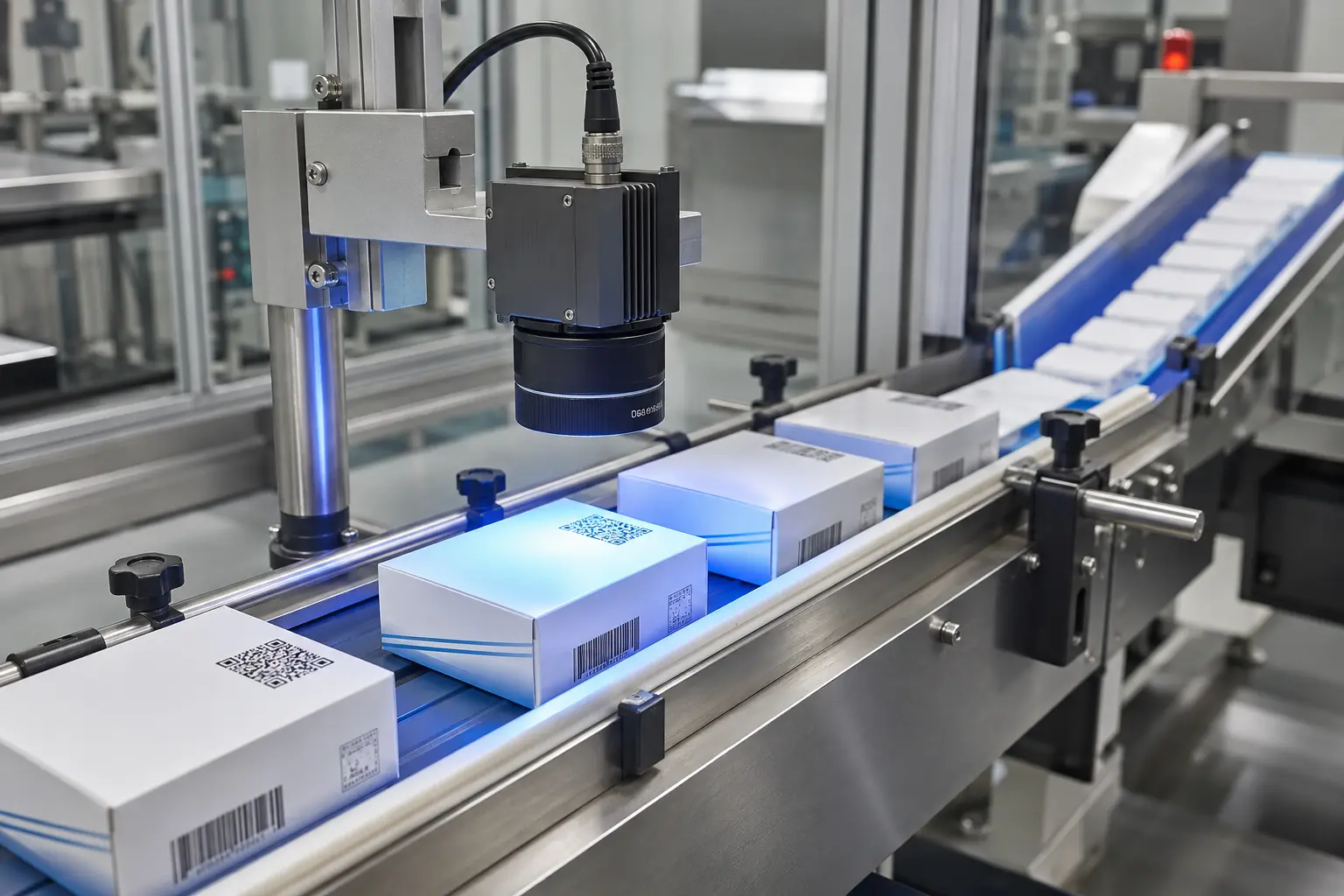
One pack, one resultIdentity • print • code • reject
How it works
Build the inspection around the failure modes
The useful question is not simply ‘can the camera see it?’ It is ‘what must be true before this product is allowed to continue?’ The answer becomes a controlled inspection recipe for each SKU.
- 01
Confirm product identity
Compare the decoded GTIN, SKU or internal code with the active work order and expected packaging.
- 02
Inspect variable information
Read or verify dates, batch numbers, lot codes and other printed fields using OCR or OCV where appropriate.
- 03
Control every failure
Track the failed item to a suitable reject device, confirm removal and stop the line if the fault route is not completed.
Specify the right system
Packaging verification requirements to define
Separating these requirements prevents an apparently successful scan from hiding a wrong product or wrong print decision.
| Requirement | What the system checks | Why it matters |
|---|---|---|
| Pack identity | Expected barcode or visual feature | Stops product and packaging mix-ups |
| Variable print | Date, lot, batch or price text | Detects missing, incorrect or illegible fields |
| Code quality | Decode, data structure or grade | Aligns acceptance with downstream scanning needs |
| Fault handling | Tracking, reject and confirmation signals | Prevents an inspected failure remaining in good output |
Project route
From application review to production control
Performance depends on the real pack, print process, speed and fault route. Those conditions are proved before the final system is released.
Define the risk
List every wrong-pack, wrong-code and missing-print condition that must fail.
Trial real packs
Test representative colours, surfaces, print variation, speed and presentation.
Integrate controls
Connect job data, cameras, PLC signals, handling and the reject route.
Prove acceptance
Challenge each fault, confirm records and train operators on recovery.
Common questions
Packaging verification FAQs
These answers cover the first decisions. A sample trial establishes what is practical on your line.
Ask an engineerCan one system inspect the barcode, label and date code?+
Yes, when the fields can be imaged at the required resolution and presentation. One or more cameras can combine the results into a single product decision.
Can packaging verification be retrofitted to an existing line?+
Often. A survey confirms space, guarding, product handling, controls, line speed and the available reject point before a retrofit is specified.
Does every failed pack need an automatic reject?+
Not always, but the fault response must be defined. Depending on the process, the system can reject, stop the line, hold product or request an operator decision.
Can recipes change with the active product?+
Yes. Product recipes can select expected codes, text, inspection regions, tolerances and data sources, with changeover confirmation where required.
Oxford Vision Systems
Define what a correct pack must prove
Share representative packs, the active job data and your target line speed for an initial review.
What does a product verification system check?
A product verification system compares visible product, packaging, label and code features with the active production recipe. It can identify a wrong product-to-label combination and trigger controlled rejection before release.