
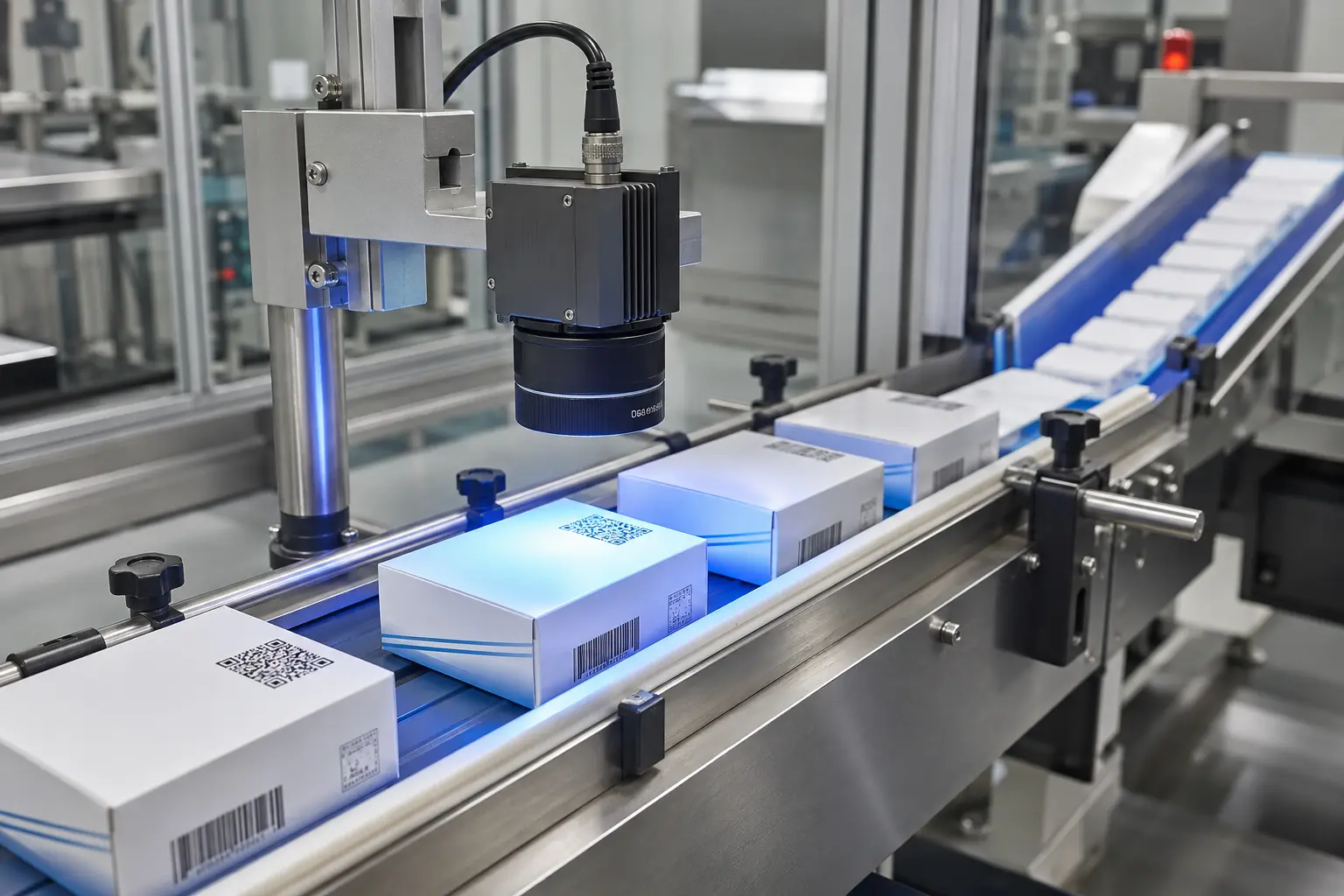
GS1-128 verification UK
GS1-128 barcode verification for cases, pallets and logistics labels
Inspect whether every GS1-128 symbol is readable, correctly structured and matched to the active product, case or logistics unit before despatch.
Short answer
A GS1-128 inspection should do more than decode the bars. It can confirm the expected GS1 Application Identifiers, validate values such as GTIN, batch, dates or SSCC, compare the result with production data and trigger a controlled response when the label or code fails.
Treat GS1-128 as both a printed symbol and structured data
GS1-128 is commonly used where a logistics label must carry more than a product number. Its element strings can identify a trade item or logistics unit and add attributes such as a batch or lot, date, serial number or measure.
A reliable production system therefore separates print quality, GS1 syntax and business-data correctness. A readable code can still contain the wrong GTIN, an unexpected Application Identifier or an SSCC that does not belong to the pallet being built.
Production outcomes
Stop a readable but incorrect logistics label
Prevent wrong-GTIN case release
Validate SSCC and variable data
Create a traceable reject decision
GS1 data verifiedSymbol • AIs • identity • control
How it works
Build one decision from image, data and production context
The inspection result becomes dependable when the camera output is compared with the authoritative product or logistics record.
- 01
Capture the whole symbol
Select optics, lighting and resolution for the label size, quiet zones, motion and print process.
- 02
Parse GS1 element strings
Identify the expected AIs and apply length, character, separator, date and check-digit rules.
- 03
Match the real logistics unit
Compare GTIN, SSCC, batch or order data with the case, pallet or shipment currently being produced.
Specify the right check
Four layers of GS1-128 verification
Each layer catches a different class of error and should have its own acceptance rule.
| Inspection layer | What is checked | Typical failure found |
|---|---|---|
| Symbol | Presence, quiet zones, dimensions, contrast and agreed grade or process limits | No-read, poor print or damaged label |
| GS1 structure | Symbology, FNC1 behaviour, AIs, field lengths and valid character sets | Malformed or incomplete element string |
| Business data | GTIN, SSCC, batch, date, weight or serial against expected records | Readable code carrying incorrect data |
| Production control | Active SKU, label identity, reject confirmation and result record | Correct code applied to the wrong case or pallet |
Primary reference: GS1 UK describes GS1-128 uses and data. The current GS1 General Specifications and your customer specification should define the exact carrier, data and quality requirements.
Project route
From sample code to controlled production
Performance depends on the real symbol, substrate, line speed and fault route. Those conditions are proved before the final system is released.
Define the GS1 message
List required AIs, field rules, data source and downstream customer requirements.
Trial real labels
Test normal print variation, label position, speed, surface and scanner presentation.
Connect production truth
Link the active SKU, order, serial pool, SSCC source or warehouse data.
Challenge every fault
Prove no-read, wrong data, duplicate, communication loss, reject and recovery scenarios.
Technical content reviewed by the Oxford Vision Systems engineering team. Updated 1 September 2026.
Common questions
GS1-128 verification FAQs
These answers cover the first decisions. A sample trial establishes what is practical on your production line.
Ask an engineerWhat information can a GS1-128 barcode contain?+
GS1-128 can carry GS1 identifiers and attributes selected through Application Identifiers, including GTIN, SSCC, batch or lot, dates, serials and measures. The permitted combination depends on the application.
Is an SSCC the same as a GTIN?+
No. A GTIN identifies a trade item, while an SSCC identifies an individual logistics unit such as a pallet or shipping unit. The inspection should apply the correct rule to each field.
Can the system detect a correct code on the wrong case?+
Yes, if the decoded GTIN or other identity is compared with the active SKU, work order or upstream product signal rather than accepting any readable GS1-128 symbol.
Can GS1-128 print quality be graded in-line?+
An engineered system can assess agreed quality characteristics, but the required method, aperture, calibration, presentation and evidence must be defined. Formal verification requirements should be distinguished from process monitoring.
Oxford Vision Systems
Prove the GS1-128 label before despatch
Share label samples, required AIs, line speed and the source of expected product or SSCC data for an initial review.