
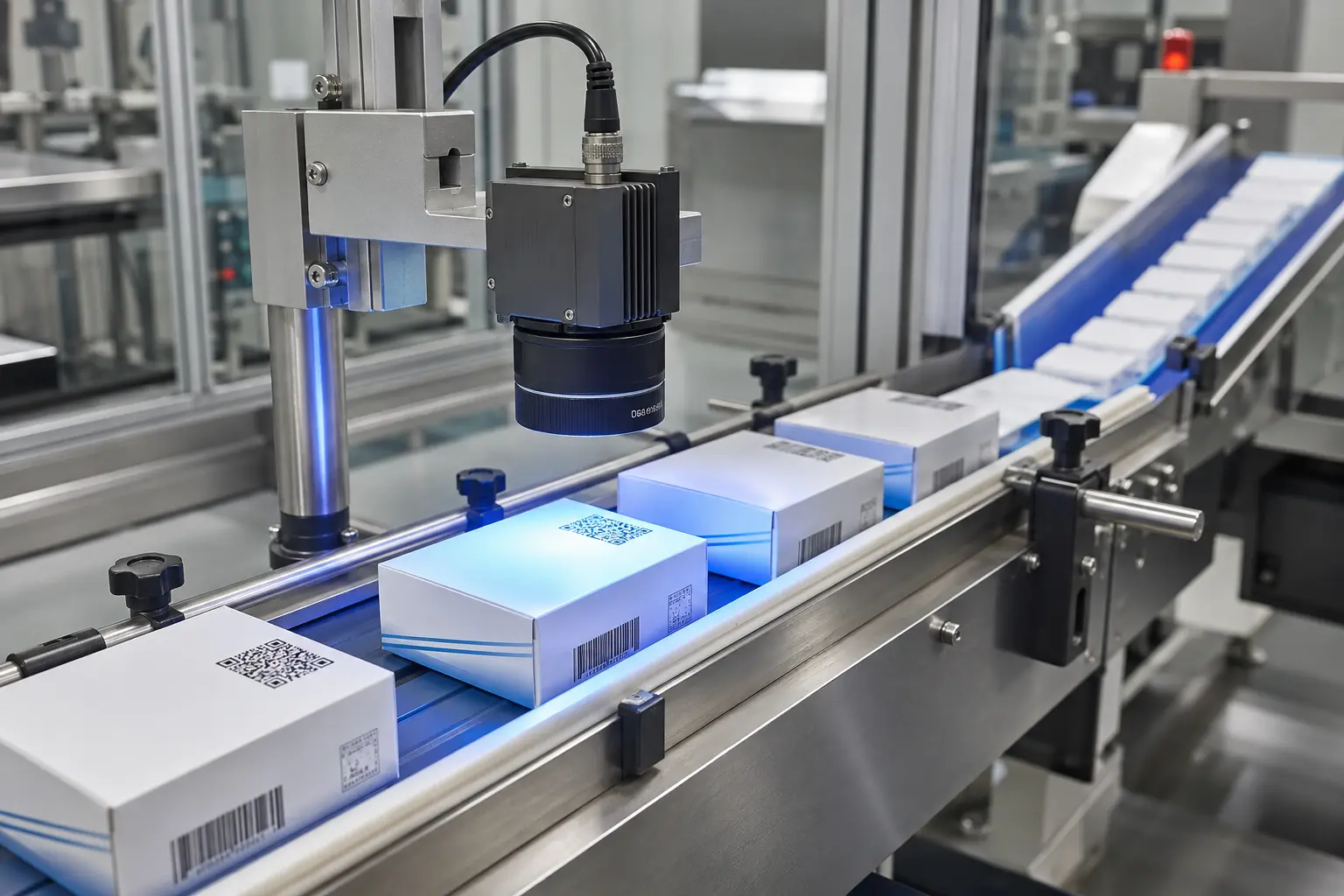
ITF-14 case-code inspection UK
ITF-14 barcode verification for outer cases and corrugated cartons
Check every outer-case code for readability, correct GTIN-14 data and production-line identity before cartons enter warehousing or distribution.
Short answer
ITF-14 is designed for traded units such as cases or cartons and is well suited to direct printing on corrugated material. In-line inspection can check that the symbol is present and readable, validate the GTIN-14 and check digit, assess agreed print characteristics and confirm the case matches the active product.
Control the code where print and board quality vary
Corrugated board, flexographic print, case movement and surface variation can all reduce the margin available to downstream scanners. An inspection should be tested on representative board, inks, case sizes and normal production speed.
The data decision is equally important. A clean ITF-14 symbol can still encode the wrong trade-item identity. Comparing the captured GTIN-14 with the active case recipe closes that gap.
Production outcomes
Protect case identification before distribution
Stop an incorrect GTIN-14
Monitor direct-print deterioration
Remove failed cases automatically
Case identity checkedGTIN-14 • print • product • reject
How it works
Inspect the actual shipping case, not a laboratory label
The chosen lighting and field of view must handle board texture, print spread, case movement and the full location tolerance.
- 01
Present the code consistently
Control case spacing, skew and distance so the camera captures the complete ITF-14 and quiet zones.
- 02
Validate symbol and GTIN-14
Decode the symbol, apply agreed quality checks and confirm the number and check digit are valid.
- 03
Compare with the case recipe
Match the captured identity to the product being packed and trigger the defined reject or stop response.
Specify the right check
Choose ITF-14, GS1-128 or EAN/UPC for the right task
The carrier choice is an application decision; production inspection should enforce the approved choice rather than accept any readable barcode.
| Inspection layer | What is checked | Typical failure found |
|---|---|---|
| ITF-14 | GTIN on outer cases or cartons, including direct corrugated print | Wrong case identity, weak direct print or missing bearer-bar requirement |
| GS1-128 | GTIN or SSCC plus attributes such as batch, date, serial or measure | Malformed Application Identifier data or wrong logistics record |
| EAN-13 / UPC-A | Retail point-of-sale identification, including some traded units sold at retail | Wrong retail GTIN, insufficient size or poor point-of-sale quality |
| Inspection control | Expected carrier, data, product recipe and failed-case handling | Readable but unapproved symbol or wrong code on the case |
Primary references: GS1 UK guidance for cases and traded units and GS1 UK case-barcode guidance. Confirm the current GS1 and customer specification before setting acceptance limits.
Project route
From sample code to controlled production
Performance depends on the real symbol, substrate, line speed and fault route. Those conditions are proved before the final system is released.
Confirm the carrier
Establish why ITF-14 is specified and whether the case could also be sold at retail.
Trial production board
Test normal corrugated, ink, print pressure, code location, speed and case movement.
Set product matching
Connect the active GTIN-14 or recipe so a readable wrong code cannot pass.
Prove failed-case handling
Challenge no-code, no-read, wrong-GTIN, weak-print and reject-confirmation conditions.
Technical content reviewed by the Oxford Vision Systems engineering team. Updated 1 September 2026.
Common questions
ITF-14 verification FAQs
These answers cover the first decisions. A sample trial establishes what is practical on your production line.
Ask an engineerWhat is an ITF-14 barcode used for?+
ITF-14 is used to identify traded units such as cases or cartons and can be suitable for direct printing on lower-quality materials such as corrugated board.
Does every ITF-14 need bearer bars?+
Bearer-bar requirements depend on the printing method and applicable GS1 specification. The project should confirm the approved symbol construction rather than assume one layout for every case.
Can ITF-14 carry batch or expiry data?+
ITF-14 carries a GTIN. Where additional attributes such as batch, date, serial or measure are required, GS1-128 or an approved 2D carrier may be more suitable.
Can a camera verify the GTIN-14 against the product?+
Yes. The decoded value can be compared with the active case recipe, work order or upstream product signal so a readable but incorrect code fails.
Oxford Vision Systems
Test the case code under real line conditions
Send representative cartons, approved GTIN-14 data, print method and target speed for an ITF-14 inspection feasibility review.