
GS1 Digital Link inspection UK
Inspect GS1 Digital Link and retail 2D barcodes in-line
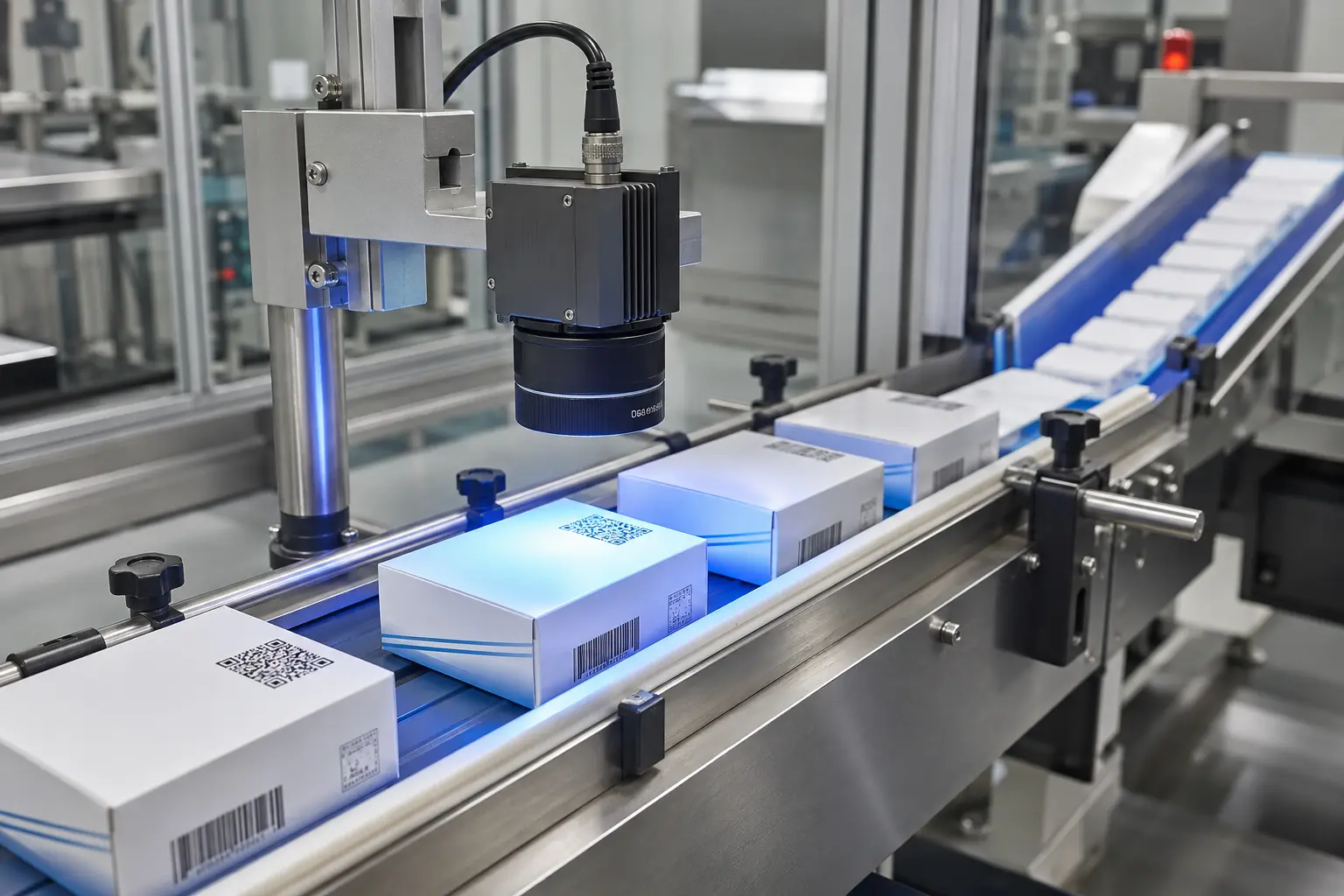
Check that the 2D symbol is readable, contains the expected GS1 identity and production data, and is associated with the correct product before release.
Direct answer
What should GS1 Digital Link inspection prove?
A production inspection should separate three questions: can the QR or Data Matrix symbol be decoded, is its GS1 data correctly structured for the application, and does the encoded product identity match the item being made? If a Digital Link URI is used, the web destination and resolver behaviour are a further system-level test rather than a substitute for print and data inspection.
GS1 UK describes GS1 Digital Link as a way to use GS1 identifiers as a gateway to online information. The production-line task is to prove that the printed carrier and encoded identifiers are correct on the right product, using 2D code inspection and GS1 data validation.
Production outcomes
Prepare the printed code and production data together
Validate expected GS1 identifiers
Match the code to the active SKU
Detect faults before retail or supply-chain use
2D code controlPrint • data • product • destination
How it works
Treat the code as both a symbol and a data carrier
The camera sees modules, contrast and geometry; the decoder returns content; business rules decide whether that content belongs on the current product. A robust project keeps those layers visible rather than reducing the result to one green decode light.
- 01
Inspect the printed carrier
Control resolution, lighting, quiet zones, placement and production variation for the chosen 2D symbology.
- 02
Parse the GS1 information
Extract the identifier and any agreed batch, expiry, serial or other application data for validation.
- 03
Match the physical product
Compare the decoded identity with the active recipe or master data and apply the defined fault route.
Specify the right system
Four tests for a connected 2D barcode
Each test catches a different failure and may be owned by a different part of the project.
| Requirement | What the system checks | Why it matters |
|---|---|---|
| Symbol test | Can the printed QR or Data Matrix be decoded? | Finds print, damage and presentation faults |
| Data test | Are identifiers and attributes structured as expected? | Finds malformed or missing information |
| Product test | Does the GTIN or item identity match the SKU? | Prevents a correct code on the wrong product |
| Link test | Does the URI resolve to the intended online experience? | Checks the digital destination outside the camera decision |
GS1 reference: GS1 UK’s 2D barcode guidance explains the roles of QR codes, GS1 DataMatrix and GS1 Digital Link. The applicable GS1 specification and customer requirements should be confirmed for each rollout.
Project route
From application review to production control
Performance depends on the real pack, print process, speed and fault route. Those conditions are proved before the final system is released.
Define the use case
Confirm retail, traceability, consumer-link and supply-chain data requirements.
Create test symbols
Include valid, invalid, damaged and wrong-product examples at production size.
Connect master data
Agree the authoritative GTIN, attributes, URI rules and active SKU signal.
Validate end to end
Challenge print, parse, product-match, resolver and reject scenarios.
Common questions
GS1 Digital Link inspection FAQs
These answers cover the first decisions. A sample trial establishes what is practical on your line.
Ask an engineerIs GS1 Digital Link a type of QR code?+
GS1 Digital Link is a standards-based way to express GS1 identifiers in a web URI. That URI can be carried in a QR code; the carrier and the encoded data are separate layers.
Can the same code support point of sale and online information?+
GS1 guidance describes 2D barcodes using GS1 standards as capable of supporting business processes and digital information. The chosen carrier, data and retailer requirements must be confirmed.
Does a working web link prove the printed code is acceptable?+
No. A link can resolve while the symbol is poorly printed or attached to the wrong product. Print, data, product association and destination should be tested separately.
Can an existing line be prepared for 2D barcode inspection?+
Often. Trials establish the required resolution, field of view, lighting, speed, data connection and reject point for the new symbol and pack range.
Oxford Vision Systems
Prepare the line for connected 2D barcodes
Share sample codes, GS1 data requirements, packaging and speed for an initial inspection review.
Check that linear and 2D barcodes identify the same product
When a pack carries both a familiar linear barcode and a new 2D symbol, test them as a pair. Each symbol may read successfully while the two encode different product identities. This can happen when artwork, variable printing and product master data are updated through separate workflows during a packaging change.
Give the inspection project the approved identifiers and explain which information should agree. The product identity should be checked using the applicable GS1 representation; a literal comparison of the complete decoded strings is usually inappropriate because a Digital Link URI can contain additional attributes and web syntax. Batch, expiry or serial information needs its own matching rule where it is part of the requirement.
Use approved artwork alongside a deliberately mismatched pair to demonstrate the intended decision. Also check each symbol's position, size and surrounding clear area on the finished pack, because adding the second carrier can crowd existing graphics. Keep retailer requirements and the online destination review in the brief. Pair checking strengthens product identification, while formal barcode grading remains a separately specified measurement.
Can both barcodes scan and still identify different products?
Yes. Successful decoding does not prove that the two product identifiers agree with each other or the active SKU.
Should a Digital Link URI exactly equal the EAN barcode text?
No. Compare the relevant GS1 product identity after appropriate parsing; the URI may also contain other attributes and web syntax.
Check the barcode against the active product Specify formal barcode quality grading