
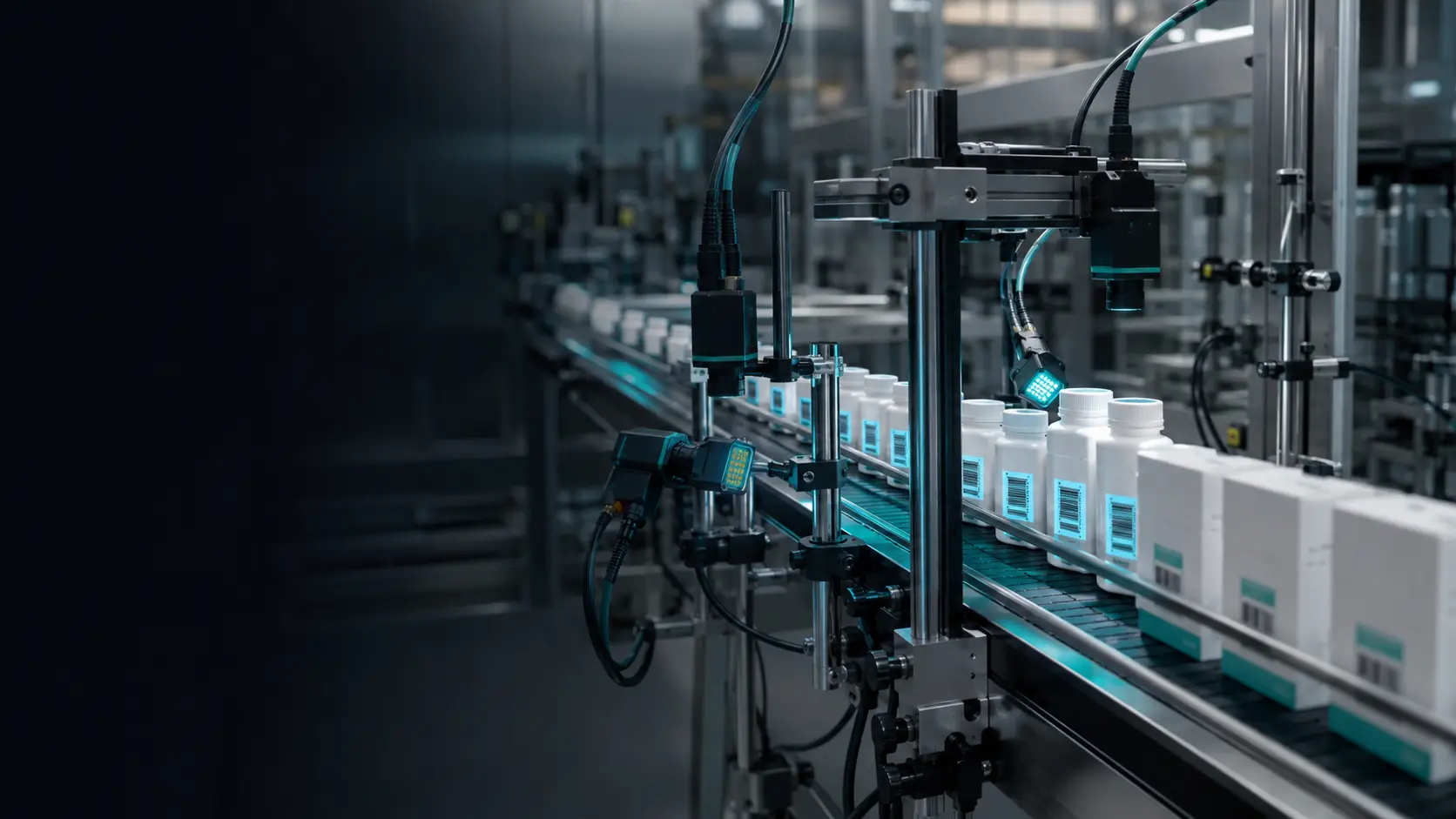
Inline barcode checking guide
Barcode checking, validation or verification: which do you need?
A production barcode can decode successfully and still contain the wrong data or have weak print quality. This guide separates the three decisions so your specification covers the real risk.
Direct answer
The difference in one minute
Barcode checking normally asks whether a code is present and decodable. Data validation asks whether the decoded value, format or product identity is correct. Barcode verification or grading measures symbol-quality characteristics using a defined method, such as ISO/IEC 15416 for linear symbols or ISO/IEC 15415 for 2D symbols.
Manufacturers often need more than one layer. An in-line system may check every pack and compare its data, while a controlled verifier or appropriately engineered grading process assesses print quality. The required evidence, speed and acceptance threshold should be agreed before equipment is selected.
Production outcomes
Use the right term for the result you need
Validation: is the decoded data correct?
Grading: how well is the symbol printed?
Control: what happens when it fails?
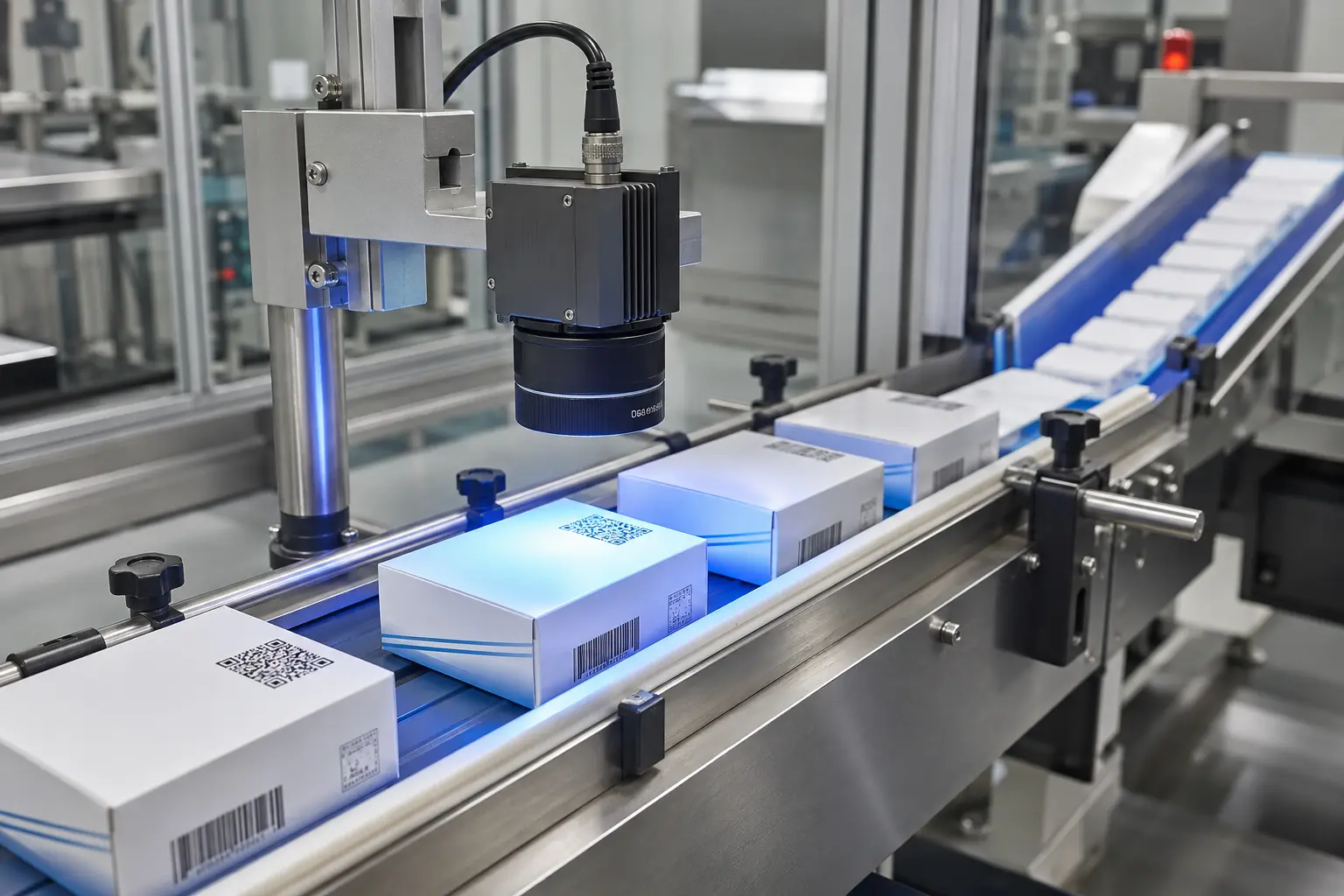
Four layersRead • validate • grade • control
How it works
A decode alone does not answer every question
A reader is designed to recover data. That is valuable, but the result does not by itself prove that the encoded GTIN belongs to the product, that GS1 fields are structured correctly, or that the symbol has the required print-quality grade.
- 01
Readability
Confirm the code can be located and decoded under the controlled production setup.
- 02
Data validity
Apply product, database, sequence, check-digit or application-specific rules to the decoded value.
- 03
Symbol quality
Measure the relevant linear or 2D quality parameters with the required method and calibration discipline.
Specify the right system
Barcode inspection language for a clear specification
Use these questions in a user requirement specification or application review.
| Requirement | What the system checks | Why it matters |
|---|---|---|
| Checking / reading | Can the system decode the code? | Detects missing and unreadable symbols |
| Validation | Does the value satisfy product and data rules? | Detects wrong or malformed data |
| Verification / grading | How does symbol quality score against a method? | Measures print-quality performance |
| Inspection control | Was the failed product removed and recorded? | Completes the production fault route |
Standards reference: ISO describes ISO/IEC 15416:2025 for linear symbol print-quality measurement and ISO/IEC 15415:2024 for two-dimensional symbols. The required standard, aperture, lighting and minimum grade should be confirmed for the application.
Project route
From application review to production control
Performance depends on the real pack, print process, speed and fault route. Those conditions are proved before the final system is released.
State the risk
Separate no-code, no-read, wrong-code, malformed-data and low-grade failures.
Define the evidence
Agree whether each pack, samples or a controlled verifier must provide the result.
Trial production
Test the code at real size, print quality, motion, orientation and line speed.
Document acceptance
Record thresholds, reject logic, challenge tests and operator response.
Common questions
Barcode checking FAQs
These answers cover the first decisions. A sample trial establishes what is practical on your line.
Ask an engineerIs a barcode reader the same as a barcode verifier?+
No. A reader is primarily designed to decode data. A verifier measures defined symbol-quality parameters under controlled conditions and reports a grade.
Can an inline system grade every code?+
Some engineered systems can provide in-line grading measurements, but suitability depends on the applicable method, optics, calibration, presentation and required evidence. The specification must be explicit.
What is barcode validation?+
Validation applies rules to decoded data—for example the expected GTIN, length, format, check digit, sequence or database record.
Which standard applies to 1D and 2D codes?+
ISO/IEC 15416 covers linear symbol print-quality methodology, while ISO/IEC 15415 covers two-dimensional symbols. Other application or direct-part-mark standards may also apply.
Oxford Vision Systems
Specify the result before choosing the reader
Share the code type, downstream requirement, product data and production conditions for an application review.